

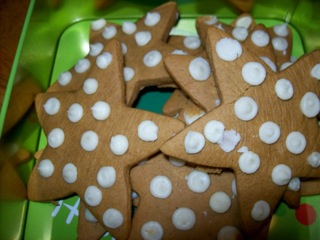
Each week I chat with Matt Swaim on the Sonrise Morning Show, Sacred Heart Radio. Today we talked about the legend of Victorian manger herbs and I also shared a fun gingerbread cookie recipe for the holidays. The one shared today is from neighbor, Erin Phillips. Check this site out for another, softer version from daughter-on-law Jessie. Both are yummy!
So let’s talk about the legend of manger herbs:
On the starry night when Christ was born, according to the legends, Joseph gathered herbs and grasses t cradle his newborn son. Among them were bedstraw and pennyroyal, horehound and thyme, rosemary and lavender: These are the herbs of the manger.
When we look into decorating the season using different Advent or manger herbs, it makes us appreciate Advent and the true meaning of Christmas. So regardless of whether you call it a manger crib or a crèche, we like to tuck in some of these herbs that are descendants of the very plants which were being grown and used over two thousand years ago.
When did the tradition start?
This tradition grew during Victorian times, when Victorian households used many of these herbs in their manger scenes.
Like bedstraw: Mary laid the baby on bedstraw, a plant of the fields and roadsides. Farmers fed it to cows to sweeten their milk, and stuffed mattresses with it, too.
Bedstraw was common in stables. And until this night, the stories say, it was no more than an everyday weed, with plain white flowers and no fragrance at all.
But when the Christ Child’s head touched the bedstraw, the plant was forever changed. Its blossoms turned golden, and its narrow leaves were imbued with a sweet, fresh scent.
When children in Sicily visit a creche, they tuck sprigs of pennyroyal into the straw. Some say this plant, too, was transformed as it lay in the manger.
Pennyroyal, a strong scented mint, was a low-growing weed, hadn’t a single flower. But Joseph loved the aroma and picked it for the baby’s bed.
At the moment that Jesus was born, the little herb burst into bloom. Since then pennyroyal has carried bright purple blossoms — a royal hue, fit for a king.
One can imagine a young mother smiling, her baby asleep among flowers. But more sinister herbs also pillowed the Christ Child’s head, hinting at sorrows to come. Like horehound that Joseph gathered from Bethlehem’s fields.
Horehound is still growing abundantly in my herb garden. If you feel it the leaves are soft like felt.
So horehound actually represented both past and future, because it symbolized Jesus’ Jewish roots — and foreshadowed a bitter betrayal.
The legend is that Mary cried when she saw horehound there in the manger. She tried to pluck it from the straw hoping to change Jesus’ fate, but its stems were twined tightly among the other herbs and grasses.
The symbolism here is that some things just cannot be changed and we all have challenges in our life. But as Mary picked through the straw and horehound, she found another herb: thyme, a symbol of courage and endurance. it grows wild upon the hills of the Holy Land.
Rosemary and lavender were among the manger herbs
Lavender symbolizes purity and virtue.
Rosemary represents love and loyalty. Legend has it that rosemary will not grow taller than Jesus when he was on earth – 6 feet – or live longer than his 33 years.
Even now, some folks make sure to have rosemary in the house on Christmas Eve, to bring luck.
What about those rosemary topiary trees you find at the grocery store now? How do you take care of them?
Rosemary is known as an “upside down” plant. It likes its roots fairly dry, not soggy but rosemary does best in a bright area where the leaves can pick up moisture from the air. So make sure you have good air circulation so the plant doesn’t pick up mold on its leaves but give it a spritz of water every now and then.
ERIN’S GINGERBREAD CUTOUTS
From neighbor and friend, Erin Phillips.
Ingredients
1/2 cup butter
1/2 cup sugar
1/2 cup molasses
1 egg
2 cups flour
1 teaspoon baking soda
1/2 teaspoon ginger
1 teaspoon cinnamon
1/8 t teaspoon ground cloves
Instructions
Preheat oven to 350.
Melt butter, sugar and molasses. Let cool a bit and then beat in egg.
Whisk flour, soda and spices together. Stir into egg mixture. It will be sticky.
Refrigerate at least 2 hours or more, then roll out 1/4″ on floured surface to keep from sticking. Cut as desired and place an inch apart on sprayed or parchment lined cookie sheets. Bake 8-10 minutes.
 About Eating
Thank you for having this on line. I lost my best recipe and want to try making gingerbread men again.
LikeLike
Oh gosh, Karen, so glad you found it. Let me know how it works out.
Blessings,
Rita
LikeLike
Rita, The recipe you have in “About Eating” has a good taste. I am having trouble with the timing because I recently got a new GE electric stove. The burners have a temperature so hot I dare not turn them on at the highest setting without being next to the stove. The cookies turned out to be too hard since I don’t understand the timing with a new electric oven. This is the first time I’ve had a digital stove. I found my good recipe in a cookbook. See below:
Crispy Gingerbread Cookies
A big recipe to bake ahead of time and freeze. These sturdy cookies make ideal ornaments. Great for large cookie Cutters!
5 1/2 cups sifted flour
1 TBL baking soda
2 tsp baking powder
1 tsp baking powder
1 tsp salt
1 tsp cinnamon
3/4 tsp ginger
1/4 tsp cloves (I added)
1 cup shortening
1 cup sugar
1 egg, beaten
1/2 tsp vanilla
1 cup dark molasses
1/2 cup strong coffee (I left out)
Sift together flour, soda, baking powder, salt, ginger and cinnamon. Cream shortening; add sugar gradually; beat until light; eggs and vanilla. Add molasses and coffee, then sifted dry ingredients; mix well; chill.
Roll out on lightly floured board 1/4″ thick. Cut with ACME Cookie Cutters of desired shapes; place about 1″ apart on greased baking sheet. Bake in hot oven, 400 degrees 8-10 minutes. Spread on racks to cool. Makes 12 dozen 2″cookies or 6 dozen 5″ gingerboy/girl cookies.
Karen Evert
LikeLike